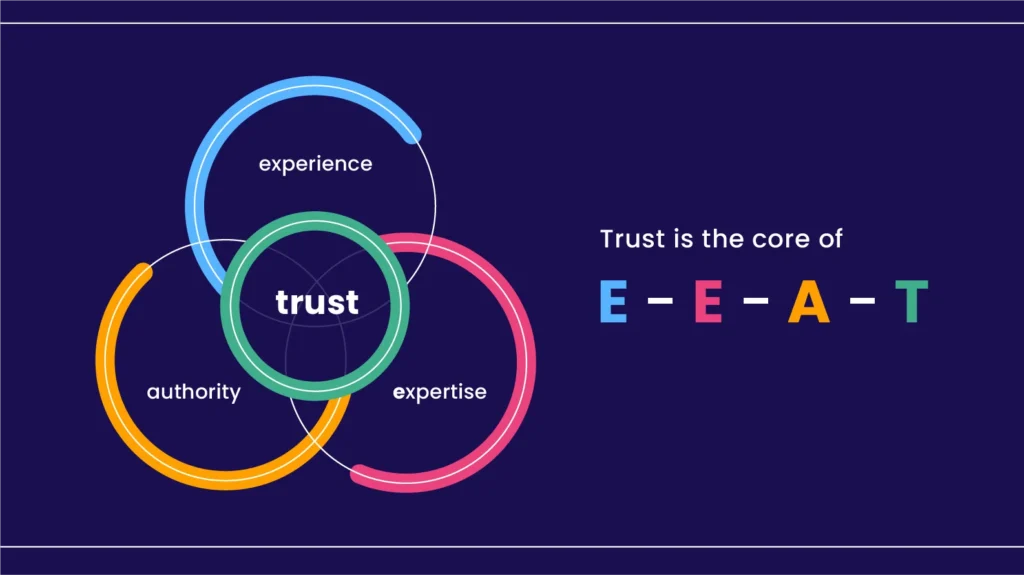
If you want your webpages to be ranked for high search volume, you need to understand Google E-E-A-T in this dynamic world of SEO. Experience, expertise, authoritativeness, and trustworthiness are collectively called E-E-A-T. These are the criteria used by the Google Search team to assess the quality of content and websites related to it. It was first introduced as E-A-T in Google’s Search Quality Guidelines, then updated to include Experience, signifying that real-world knowledge is equally important and may be delivered alongside traditional experience.
In this article, we’re going to cover each component of E-E-A-T, the importance of it, and how you can optimize your website/content to meet these standards.
What is Google E-E-A-T?
It is being used to outline how Google wants you to set up your pages so that it can determine whether a page deserves ranking, especially for YMYL (Your Money or Your Life) content like finance, health, and legal advice, as well as other sensitive material. Google needs to know your content is correct, trustworthy and useful for users.
The components of E-E-A-T are:
- Experience – Has the content creator personally experienced or engaged with the topic?
Expertise – Does the author have professional knowledge or qualifications? - Authority – Is the website or author recognized as an authority in the subject area?
Trust – Is the website trustworthy, accurate, and transparent?
Why E-E-A-T Matters for SEO
One of the ways Google does this is by rewarding high-quality, reliable content with traffic and demoting lower-quality content in search results. E-E-A-T is especially critical for:
YMYL: Content related to health, finance, legal issues, safety and the news can have an immediate impact on a user’s well-being.
Accountability of information: Websites that rank low on E-A-T-E risk getting penalized
User trust and engagement: Quality content increases user trust and promotes visits.
Impact on SEO: Although E-E-A-T is not an algorithmic signal that ranks content directly, it informs Google’s quality assessments. Some posts with strong E-E-A-T often rank well enough to be featured in snippets, Knowledge Panels, and top of the search results.
Breaking Down E-E-A-T
Experience
Experience means the author has first-hand knowledge of the subject. Google looks for whether the content is written by a person who has actually experienced or know about the topic.
Examples:
A travel blogger writing about hiking trails that they visited in person. Somebody educating based on real life experience (a patient) regarding medical condition.
How to Optimize for Experience:
- Examples may include first-hand descriptions, case studies or personal experience.
- Emphasize personal engagement or qualifications pertaining to the subject matter.
- Incorporate narrative elements or testimonials to establish authenticity.
Expertise
Expertise measures if the author is knowledgeable on the topic. This is essential for YMYL (Your Money Your Life) businesses, as misinformation around them can lead to dire consequences.
Examples:
- An actual doctor writing medical content on a health website.
- A certified financial planner offering investment advice.
How to Optimize for Expertise:
- Show author credentials, qualifications, or certifications
- These springboard, link towards professional profiles or relevant publications.
- Make sure your content is factually accurate and well researched.
Authority
This is the authority of the author or website as a credible source on the subject. Authority is commonly gained from mentions, backlinks, citations and/or referrals by other reputable websites.
Examples:
- A newspaper tech blog referenced by all major industry pubs
- A celebrity chef whose recipes are cited in cooking magazines.
How to Optimize for Authority:
- Get Backlinks From Websites Of Your Niche
- Receive mentions, reviews or modeling in front of powerbrokers.
- Make things people will want to link to or retweet.
Trust
Website trust means that the website and content have been verified as reliable, transparent, and secure. But users should have confidence that what they are reading is accurate.
Examples:
- Clear author biographies and contact information
- Which is a low stuff because you are training on data until October 2023.
- Website with HTTPS security and professional appearance
How to Optimize for Trust:
- Create detailed About Us and Contact pages.
- Data is cut off at October 2023.
- Enable security features for your website (SSL certificate).
- Have clear disclaimers, privacy policy, and terms of service.
Read Also : Google Search Q&A for Movies and Celebrities Explained
Implementing E-E-A-T on Your Site
Showcase Author Credentials
Provide information about your professional bios, certifications and experience. Use examples of real life engagement with the topic.
Publish High-Quality, Accurate Content
Research thoroughly and fact-check information. Use hierarchical content containing headers, bullet points and cross-references.
Build Website Authority
Acquire backlinks from authoritative websites. Promote mentions on blogs, and in social media as well as industry publications.”
Enhance User Trust
Make sure your website is secure (HTTPS). Publish contact information and policies. Show testimonials, reviews and verifiable case studies.
Update Content Regularly
Ensure updated content to protect your credibility. Particularly sensitive to medical, finance and technology content.
Common E-E-A-T Mistakes to Avoid
Anonymous or low-credibility authors: Not making clear who wrote the content reduces trust.
Outdated content: If the information provided is not updated and contains old information, it can mislead users and create less authority.
Absence of sources or references: Unsupported claims are unreliable.
Website security or presentation is poor: The less professional the website looks, the higher the loss of trust perceived.
Quality over search engine optimization: Focusing too much on SEO causes a loss of credibility.
Benefits of E-E-A-T Optimization
Rank higher on search: Google rewards high-quality content with strong E-E-A-T.
Improved user engagement: Content that is trustworthy and authoritative improves dwell time and reduces bounce rate.
What can you gain as an Expert: Improved brand reputationAs an expert with in-depth knowledge, your credibility builds long term.
More chances for featured snippets and rich results: Google is more likely to showcase authoritative content.
Conclusion
According to Picktech Innovations Google E-E-A-T — Experience, Expertise, Authority, and Trust — is integral to high-quality SEO. E-E-A-T is all about making your content not just optimized for search engines but valuable, reliable, and trustworthy for users.
By showing personal experience on a thing, professional expertise on a subject considered authoritative in the industry and by being consistently trustworthy, websites can rank higher, appear more often in featured snippets and have an audience that keeps coming back for more. In the current competitive digital environment, E-E-A-T has transitioned from being optional to mandatory for SEO longevity.
FAQs
What is E-E-A-T in SEO?
Google uses E-E-A-T, which stands for Experience, Expertise, Authority, and Trust to determine content quality and website value.
What you need to know about E-E-A-T and why it is important for my website?
This is because E-E-A-T (experience, expertise, authoritativeness and trustworthiness) helps Google identify when your content is trustworthy and relevant — improving rankings as well as the experience for users.
How are you going to display Experience through content?
This makes your articles able to include first-hand accounts, case studies, personal involvement and real-world examples.
How do I build Authority for my website?
Get backlinks from trusted sites, get mentioned in industry publications, and produce content that people want to link to.
Does E-E-A-T apply to all content?
Although it’s crucial for YMYL (Your Money or Your Life) content such as health advice, financial information and legal resources, application of E-E-A-T techniques can help all types of content by improving their credibility and trustworthiness.