Search engines have changed a lot over the past 10 years. Previously, search algorithms were keyword-based in nature to identify which pages should be returned in the results. Search engines have evolved a lot since then. They examine user behavior, context and intent to return the most relevant results.
The transition fast led to a radically different approach that companies needed to take in order to succeed with search engine optimization (SEO). It is no longer enough just to target keywords for top rankings. The old school tactics don’t apply anymore and modern day SEO should be all about understanding buyer intent or the reason behind a user’s query.
This ensures that businesses remain competitive in the digital marketplace by attracting more qualified traffic and improving conversions.
What Is Buyer Intent?
Buyer intent is the reason why someone is searching for something. It mirrors a user’s intention when searching for something online.” This knowledge provides businesses with the insights to craft both content, as well as align outcomes that are congruent with their audience.
For instance, a person who searches for “what is digital marketing” probably wants introductory information about the subject. On the flip side, someone searching for “best digital marketing agency near me” most likely intends to purchase services or hire a service provider
Even though both searches are using digital marketing, the user intent is entirely different behind them. Understanding these distinctions enable businesses to present the most relevant information at each point in the shopper’s journey.
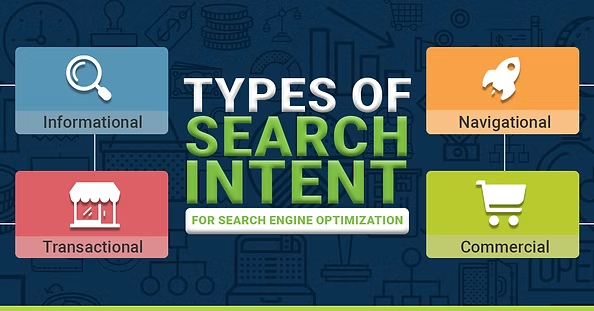
Types of Buyer Intent
Search queries can be broadly categorized into a number of categories based on user intent. Marketers can better design SEO strategies and campaigns when they have an understanding of these categories.
Informational Intent
The informational search happens when users want knowledge or how to answer specific questions. Common phrases found in these searches include:
“How to”
“What is”
“Guide to”
“Tips for”
For example:
- Steps to Start an Online Business
- What is content marketing
- Tips for improving website traffic
Informational queries usually indicate that a user is in the awareness stage of the buyer’s journey. They’re researching a topic but not ready to buy yet.
To target informational intent, businesses can create educational content such as blog posts, guides and tutorials.
As for these navigational searches, users intend to visit a specific website or brand. For example:
- Company names
- Product brand searches
- Website-specific searches
Someone who is looking for a specific company probably already has heard of the brand and just wants to go to its website or an individual page.
Navigational searches provide businesses with an advantage because they show that the brands are well-known among users.
Commercial Investigation
These commercial investigation searches are where users evaluate products or services prior to making a decision. Common keywords in these searches include:
- Best
- Top
- Reviews
- Comparison
Examples include:
- Best laptops for students
- Digital marketing agency reviews
- SEO tools comparison
At this point, users are considering their options and seeking detailed information to make an informed choice on the right solution.
Publishing product reviews, comparison articles and case studies can drive these users to your business.
Transactional Intent
Transactional searches happen when users are looking to act (buy a product, sign up for the service, etc.).
Examples include:
- Buy running shoes online
- Order pizza near me
- Subscribe to marketing software
Internal searches are indicative of high buyer intent and usually result in direct conversions.
These kinds of pages are the business product pages, service pages or landing page for transactional queries.
Reaad Also : How to Create Unique Content That Google Loves
What Search Engines Know About Buyer Intent
Today’s search engines leverage complex technologies to understand user intent and provide the best results.
Natural Language Processing
This is where natural language processing (NLP) comes into play, which enables search engines to not just match a keyword but also to make sense of what words and phrases mean.
For instance, search engines can understand that “how to lose weight” and “ways to reduce body weight” are phrases of the same meaning.
This allows search engines to better understand user queries and return results that align with the intent behind the search.
Machine Learning
Search engines utilize machine learning algorithms that constantly learn from user behavior to fine-tune results. These algorithms look at how users engage with search results, such as:
- Which links they click
- How long they stay on a page
- If they come back to search results
Search engines notice this trend and assume that the content is useful, as users consistently click on a specific result and read it.
Machine learning systems repeatedly adjust search rankings based on which content meets user intent (the implicit desire behind a search query) and ranking increasingly prioritizes results that fulfill this.
Context and Search History
Context is also important to search engines in query interpretation. Search results account for things like your location, search history or even the type of device you’re using.
For instance, if someone searches for “coffee shop,” they could see results for nearby cafés according to their location. The same guidance applies to search history: Search history can affect personalized search results.
With contextual understanding, search engines are able to provide results that are more relevant to each individual.
Why Traditional SEO Strategies No Longer Apply
Involvement of Original Content: Traditional SEO practices were heavily reliant on keyword density and backlink quantity. Although these elements remain relevant, they are not the main determinants of search results anymore.
Today, search engines prefer content based on quality, relevance, and user experience. Pages that are keyword-targeted but do not necessarily align with the user query often will have difficulty ranking.
For instance, an article optimized for the keyword “best smartphones” might perform poorly if it only lists products without adding value through comparisons, critiques or in-depth analysis.
Modern SEO needs a pretty good understanding of the user’s needs and expectations.
How SEO Strategies Must Evolve
With this buyer intent dominating today’s search landscape, it is essential for businesses to address it in order to stay competitive in their SEO strategies.
Focus on User-Centered Content
Content should be written primarily for the user, not only for spiders. And that means answering real questions, solving problems and giving actionable insights.
All Stage Content in The Buyer Journey
Most of your SEO strategy should be content for every stage of the buyer journey.
For example:
Awareness stage:
Educational blog posts and guides.
Consideration stage:
Product comparisons, case studies and extensive reviews.
Decision stage:
Landing pages, product pages, and reviews.
By addressing all the different stages, they can take users from discovery through to purchase.
Optimize for Semantic Search
This means that instead of matching exact keywords, semantic search relies on the meaning being hidden between words.
To optimize for semantic search, businesses must:
- Use related keywords and phrases
- Provide comprehensive explanations
- Cover topics in depth
- Answer common user questions
This practice allows search engines to recognize the bigger picture around content.
Improve User Experience
User experience is a big deal in modern SEO. Search engines consider things like:
- Page load speed
- Mobile responsiveness
- Content readability
- Website navigation
Websites that deliver a seamless and delightful user experience are more likely to appear higher in search results.
Apply Structured Content and Clear Organization
Well-organized information is easier to read for both readers and search engines. Improve Readability and SEO performance with headings, bullet points, and logical structure
Structured data markup can aid search engines in more precise interpretation of content within pages, enabling the display of rich results inside search listings.
Buyer Intent in SEO: What the Future Holds
However, this doesn’t mean that artificial intelligence has no use in improving search engines. SEO will continue to shift with the increasing use of voice search, conversational queries, and tailored search experiences.
Users are asking more detailed questions and wanting more accurate responses. Companies that respond with informative, organized, and intent-driven content will have the edge.
SEO in the future will not just be about algorithms but genuinely adding value to users.
Conclusion
Buyer intent is becoming one of the most crucial parts of SEO today. Forget keyword stuffing — search engines want information that meets the needs, goals, and expectations of users
Understanding the different types of search intent and crafting content that speaks to each stage of the buyer’s journey helps businesses draw more relevant traffic while also increasing conversion rates.
Here are some trends that will shape SEO with the future of search technologies. In an ever-evolving search landscape, organizations that prioritize user-centric content creation, semantic relevance enhancements, and unparalleled user experience will continue to hold their ground.
At the end of the day, SEO will always be about understanding humans and delivering them with information that is going to benefit them specifically before search engines.