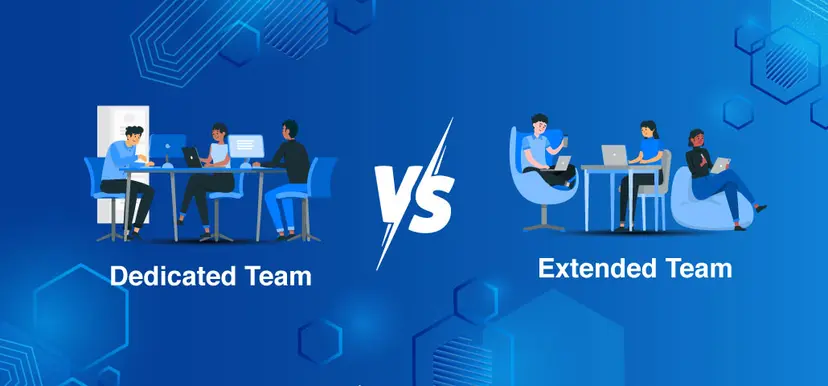
With companies turning to technology as a key driver of innovation, at-scale growth, and competition, the decision of what hiring model best fit has transformed from an operational one into a strategic one. Gone are the days when businesses had to rely only on traditional in-house hiring. Instead of that, the alternative engagement models like Dedicated Teams (DT) and Extended Teams (ET) have become great options for creating a talented, scalable, and cost-effective workforce.
Even though both the models get the work done, access to worldwide talent and long-term engagement are some of the common aspects, but it is very interesting to see how they differ in organization, control, interrelation and goal. It is important to know these differences in order for you to choose the hiring model that fits your business requirements, the complexity of the project, and the corporate culture.
In this article, we give an in-depth comparative description of the dedicated team vs extended team to help you decide which model is suitable for your project.
Dedicated Team Model
A dedicated team is a model of cooperation for the long-term perspective when a vendor forms a team to fulfill the client’s tasks. This team itself would work as a proprietary department, and it will complement the client’s internal processes, goals, and company culture.
Typically, such a dedicated team will consist of developers and designers, as well as QA specialists and project managers (sometimes other profiles too, based on specific project needs). And although the team is technically “employed” by a facility service provider, it becomes an extension of the client’s staff.
Dedicated Team: The Big Three Traits
Team dedication is essentially about exclusivity. Team members are on an assignment with a single client, and they continue to work on that client’s projects over the long term. The customer wields a lot of power over team make-up, work processes, what gets worked on, and how we measure results.
Common use cases for dedicated teams include:
- Long-term product development
- Ongoing software maintenance
- Complex or evolving projects
- Building proprietary platforms or systems
- Understanding the Extended Team Model
The Extended Team According to this model, you boost your in-house team with outside professionals. Rather than a team in its own right, the expanded lineup simply slots into the client’s internal team and works closely with other agency staff.
In such a model external people work under the client’s leadership and use internal processes and daily work flows. The primary purpose is to plug a skills gap, speed up delivery or bolster resources without the cost of permanent recruitment.
Key Qualities of an Extended Team
What extended teams are good at is being flexible; that’s what they were built for. The number of team members can vary up or down depending on work needs and project requirements. Rather than being the owner of a whole project, they more commonly work directly with internal staff on tasks or modules.
Your expanded teams can be used for:
- Skill-specific augmentation
- Short- to mid-term projects
- Scaling teams during peak demand
- Supporting internal development efforts
- Fundamental Differences Between Dedicated Team and Extended Team Models
- Although both models engage outside talent, their form and function are quite different.
Team Structure and Ownership
There is an independent team that stands altogether, only on one client. As a rule, it also possesses its own internal administration within the vendor’s organization (a team lead or project manager).
With an extended team, however, it is a component of the client’s current team. The control and allocation of tasks and decisions usually stay with the client.
Level of Control
Dedicated teams offer shared control. With the client setting goals and priorities, the vendor usually manages operations, performance control, and administration.
Remote teams provide more direct control to the client. Members outside the client adapt to the client’s own internal leadership, tools, and workflows as if they were local team members.
Engagement Duration
Long-term relationships Teams are meant for the long run. They back projects that have long evolutions involving deep domain expertise.
Extended teams can flex and work for shorter periods of time as projects require or resources become available.
Read Also : Why the Importance of CRM Portals Is Critical for Business Growth
Advantages of the Dedicated Team Model
The dedicated team is an effective model, especially if your company has large-scale development plans to implement over a long period.
Deep Business Alignment
With time, team members become quite an expert in the client’s business domain, products, and users. This results in better output and proactive problem solutions.
Stability and Continuity
With the same team in place, the knowledge doesn’t go away. This stability shortens the time of transfer, cuts off the interference, and also is good for medium- and long-term development.
Scalability with Predictability
Dedicated teams can ramp up gradually as business demands expand with a predictable cost and resource availability.
Reduced Management Overhead
Literally, vendors do HR, infrastructure, compliance, and admin work so clients can worry less about strategy and product.
Benefits of the Extended Team Model
The extended team model is based on flexibility and responsiveness and suits the dynamic environment.
Faster Team Expansion
Extended teams make it possible for companies to add experienced team members without going through the often rigorous hiring process. In time‐sensitive projects, this proves to be particularly helpful.
Direct Integration with In-House Teams
It’s also likely that extended team members are already part of existing teams, meaning collaboration is likely to be painless. Communication is more straightforward, and decisions are made more quickly.
Cost-Effective Skill Access
Renting talents only when needed limits costs of permanent employment and can help companies adapt to changing technology needs.
Greater Operational Control
Customers have complete control over prioritization, workflow, and performance, so this approach can work well for organizations that have built strong in-house leadership.
Challenges of Each Model
Each of these hiring models has its own set of challenges that must be handled deftly.
Dedicated Team Challenges
Such teams require long-term commitment, which does not fit with short-lived or experimental astrophysical projects. It may take time to achieve the initial setup and alignment, but with clear communication and set expectations, it can definitely come together in the end.
Extended Team Challenges
Extended teams are highly dependent on the client’s own management capacity. Productivity and alignment are hard to come by without strong leadership and formalized systems in place. If team members rotate very often, knowledge may not be retained equally well either.
Select the Right Model for Your Business
Whether to have a dedicated team or an extended team is determined by multiple factors.
Project Complexity and Duration
Because complex, long projects with changeable requirements need a dedicated team that provides support and stays engaged. For short-term or clearly defined projects, an extended team creates flexibility and speed.
Internal Capabilities
Companies that have strong in-house leadership and processes may get better value from an extended team. A dedicated team is often chosen by companies when they want to minimize management overhead.
Budget and Resource Planning
Dedicated teams have fixed costs per month, while extended teams give us flexibility to manage by the period, like you desire.
Strategic Goals
If the aim is to create a long-term product or innovation orbit, a dedicated team is usually preferable. An extended team is the right option when either the delivery timeline needs to be reduced or skill sets need immediate supplementation.
Culture and Communication
No matter what model is selected, success will depend on clear communication and cultural fit. The investment in onboarding, documentation, and regular collaboration makes people feel connected and empowered.
Differences in time zone, communication, and work practices need to be discussed sooner rather than later—trust is formed when we feel connected, and business does not stop because you’re apart anyway.
Conclusion
According to picktech innovations Both the Dedicated Team and Extended Team hiring models provide you with powerful mechanisms to tap into the global pool of talent and scale up development capabilities. The right decision will depend on your business goals, project complexity, operational capability, and long-term perspective.
Dedicated teams are for those who value stability, involvement, and predictable results. Extended teams are great in terms of flexibility, agility, and integrating directly with internal headcount.
By knowing the pros and cons of each model, companies can make informed choices that drive growth, innovation, and efficiencies in an increasingly competitive digital world.